
Mercredi 6 septembre 2023, à 11h
Dounia Djeghloul
Department of Biochemistry, University of Oxford, Oxford, UK
Invitée par Claire Rougeulle
“Impact of chromatin changes on mitotic chromosome structure and bookmarking”
Le séminaire se tiendra uniquement sur Zoom :
https://u-paris.zoom.us/j/86114422072?pwd=VzJ0c2pxcHl4OWppekx3MldlM2Y4QT09
Contact : sophie.polo@univ-paris-diderot.fr
Publications de l’intervenante :
Identifying proteins bound to native mitotic ESC chromosomes reveals chromatin repressors are important for compaction.
Djeghloul D, Patel B, Kramer H, Dimond A, Whilding C, Brown K, Kohler AC, Feytout A, Veland N, Elliott J, Bharat TAM, Tarafder AK, Löwe J, Ng BL, Guo Y, Guy J, Huseyin MK, Klose RJ, Merkenschlager M, Fisher AG. Nat Commun. 2020 Aug 17;11(1):4118.
Loss of H3K9 trimethylation alters chromosome compaction and transcription factor retention during mitosis.
Djeghloul D, Dimond A, Cheriyamkunnel S, Kramer H, Patel B, Brown K, Montoya A, Whilding C, Wang YF, Futschik ME, Veland N, Montavon T, Jenuwein T, Merkenschlager M, Fisher AG. Nat Struct Mol Biol. 2023 Apr;30(4):489-501.
Age-Associated Decrease of the Histone Methyltransferase SUV39H1 in HSC Perturbs Heterochromatin and B Lymphoid Differentiation.
Djeghloul D, Kuranda K, Kuzniak I, Barbieri D, Naguibneva I, Choisy C, Bories JC, Dosquet C, Pla M, Vanneaux V, Socié G, Porteu F, Garrick D, Goodhardt M. Stem Cell Reports. 2016 Jun 14;6(6):970-984.
À lire aussi
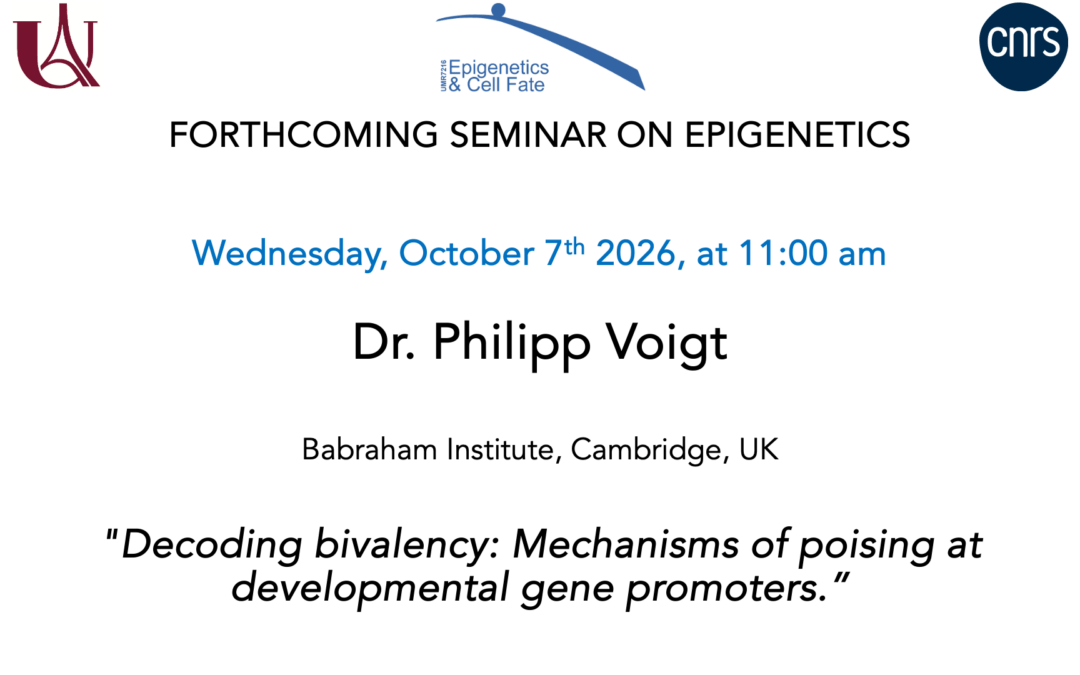
Séminaire Philipp Voigt – 7 octobre 2026
Dr. Philipp Voigt Babraham Institute, Cambridge, UK "Decoding bivalency: Mechanisms of poising at developmental gene promoters" Le séminaire se tiendra à l’Institut Jacques Monod, salle François Jacob (RB-18B). Bâtiment Buffon,15 rue Hélène Brion, Paris 13. Le...
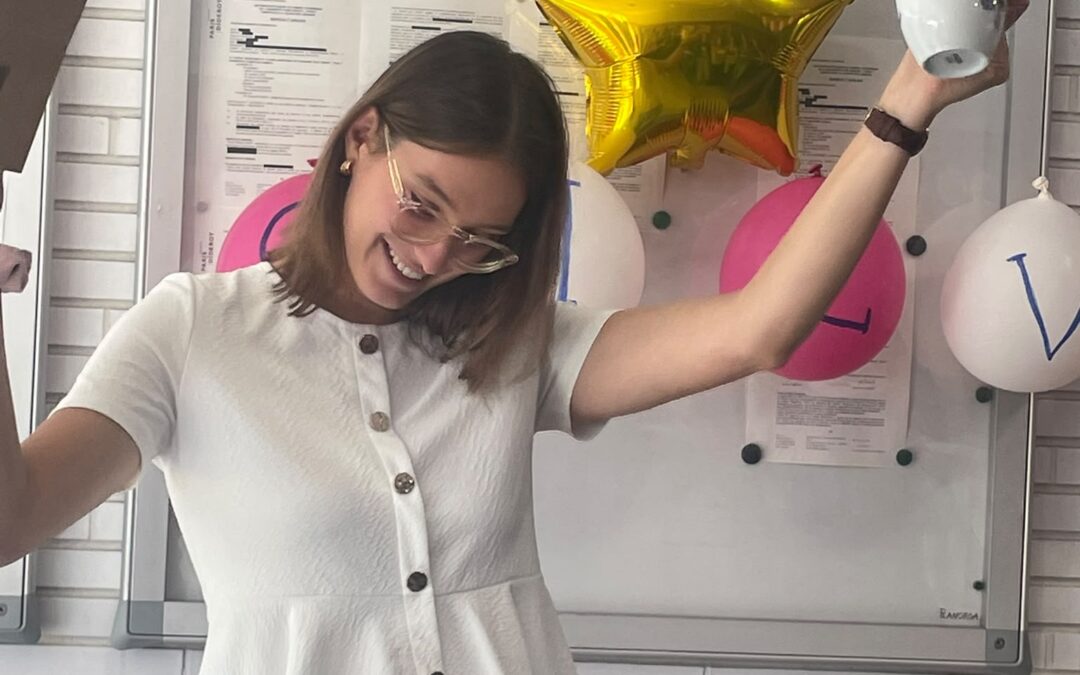
Félicitations au Dr. Silvia Comunian !
Toutes nos félicitations au Dr Silvia Comunian qui a soutenu sa thèse intitulée : «Epigenetic control of nuclear mechanics and migration via H3K9 methylation at Lamina-Associated Domains in lung cancer cells» le 25 septembre 2026. Silvia Comunian et les membres de son...
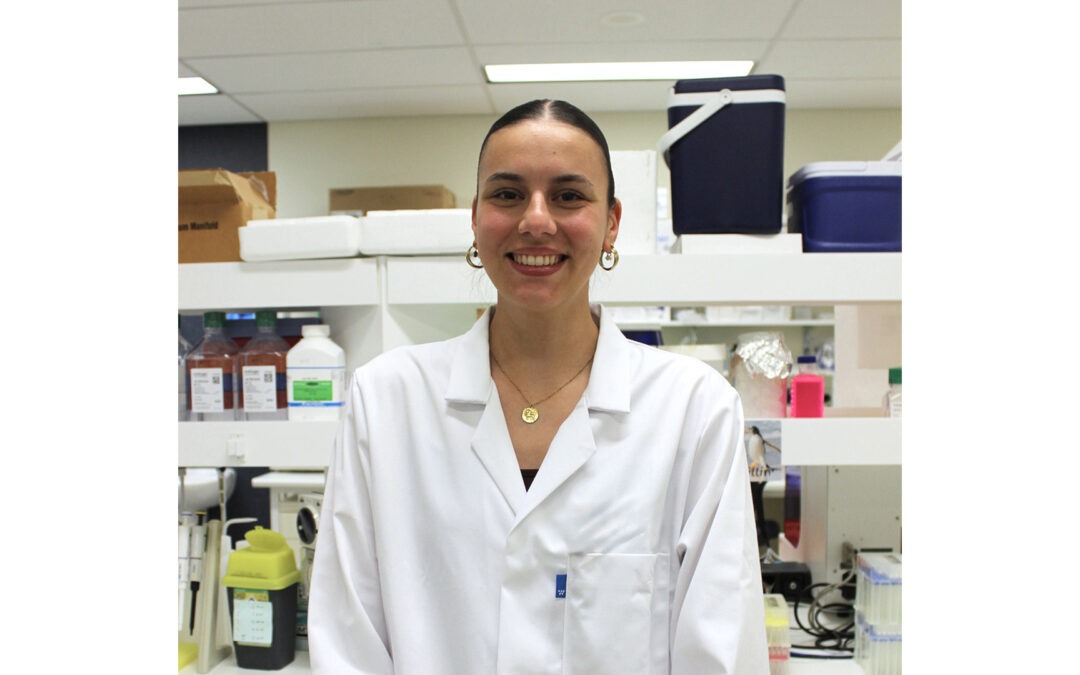
Bienvenue à Sara
Sara rejoint l’équipe pour un stage de master. Étudiante du Master Interdisciplinaire en Sciences de la Vie de l’Ecole Normale Supérieure, Sara va contribuer à un projet de recherche visant à cibler les vulnérabilités de la réparation de l’ADN dans les gliomes...
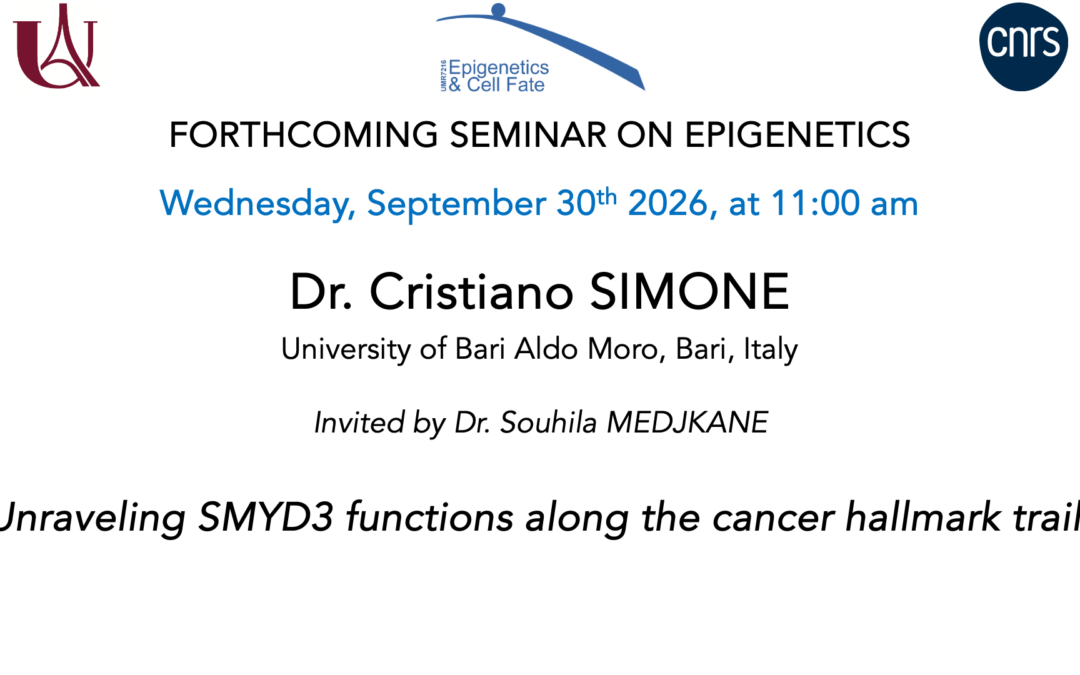
Séminaire Cristiano SIMONE – 30 septembre 2026
Dr. Cristiano SIMONE University of Bari Aldo Moro, Bari, Italy Invité par Dr. Souhila MEDJKANE "Unraveling SMYD3 functions along the Cancer Hallmark trail." Le séminaire se tiendra à l’Institut Jacques Monod, salle François Jacob (RB-18B). Bâtiment Buffon,15 rue...